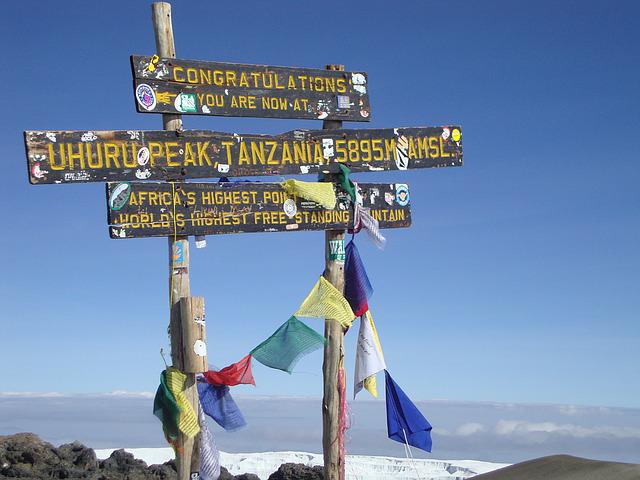

Kilimanjaro is the world’s highest free standing, snow-covered equatorial mountain. Located in North-East of Tanzania, 75,000 people climb Kilimanjaro per year. It is certainly a test of your abilities with altitude sickness, nevertheless its highly on most tourist bucket lists.
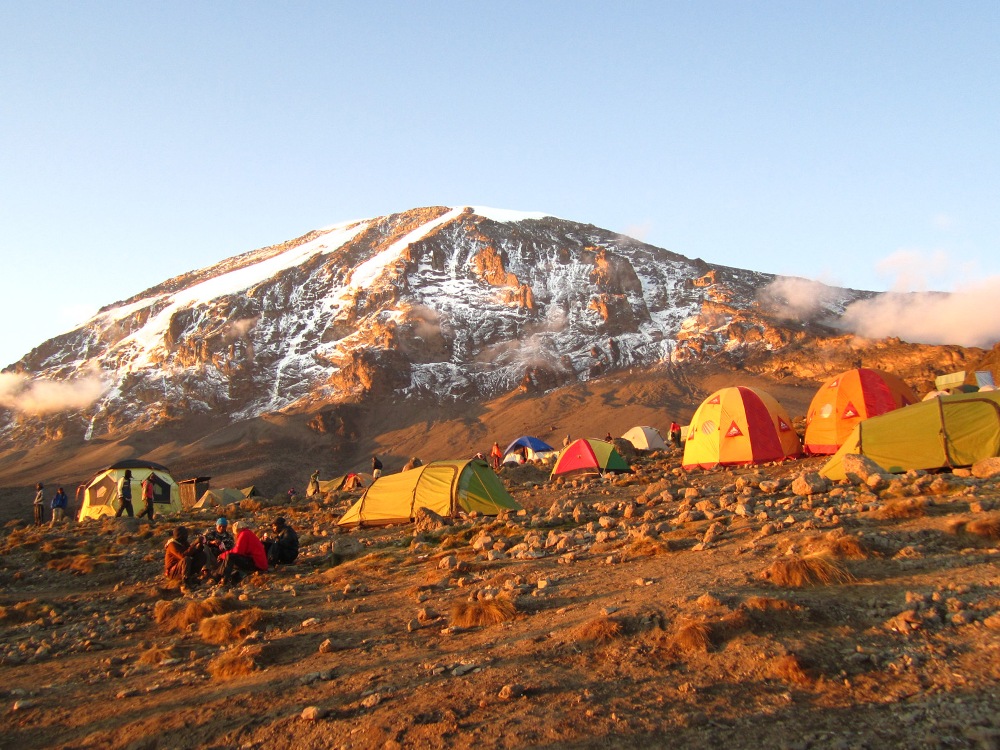
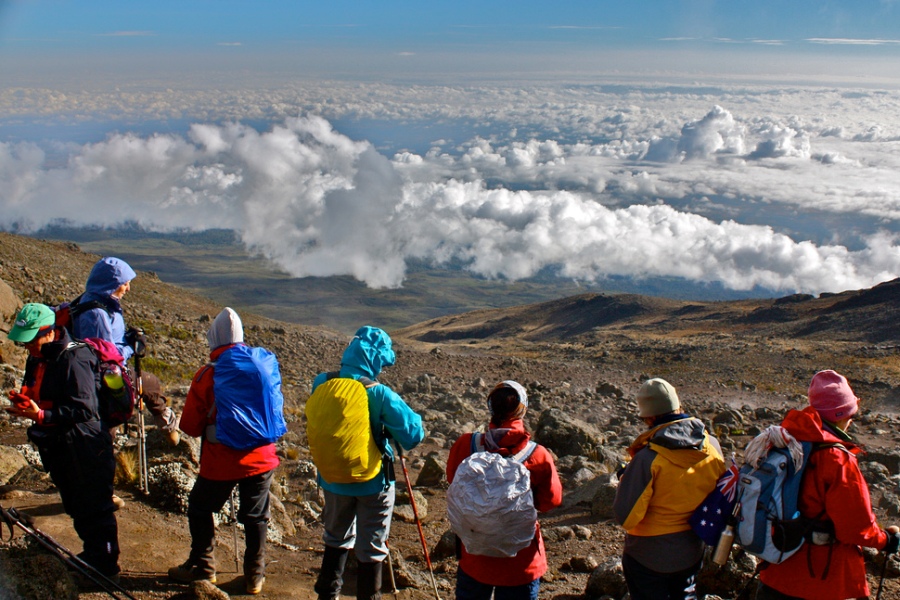
One of the most amazing aspects of the mountain is the accessibility of its peak to climbers with no mountain climbing equipment or real previous experience of scaling such heights. Although it remains a considerable feat of human endurance! The breathable oxygen at the top is less than half the amount than is common at sea level. Climbers cover at least eighty kilometres, on nothing but their own two feet to reach the top and return.
The number of climbers has escalated to over a thousand a year during the last century. The increasing numbers each year have made it necessary for the National Park to insist that all climbs are pre-booked, and passes are no longer issued at the last minute at the park gate.
Although it is possible to simply trek without relying on professional climbing equipment, it remains a hard and serious endeavor that requires a level of physical fitness. We recommend to train your stamina and a realistic awareness of the potentially damaging effects of high altitudes. You can consult a doctor before attempting to scale the mountain, and have a physical check-up for overall fitness, most tour operators require that test.
The number of climbers has escalated to over a thousand a year during the last century. The increasing numbers each year have made it necessary for the National Park to insist that all climbs are pre-booked, and passes are no longer issued at the last minute at the park gate.
With most of the old lowland forest now cultivated and settled, the first experience of the mountain environment begins with the dense vegetation of tropical montane forest between 1850m and around 2800m.
Cloud condensation mainly gathers around the forest, so this area is usually damp or drenched with rainfall, creating an intriguing mass of plant life and running rivers between endemic tree species. The area of heath just beyond the tree line also enjoys a relatively misty and damp environment as cloud clings around the density of trees.
From around 3,200m a wide expanse of moorland extends beyond the heath and the cloud line, so that here the skies are generally clear, making the sunshine intense during the days and the nights cool and clear.
The climbing incline remains gentle, but thinning oxygen provides less fuel to energise the muscles and can dramatically slow the pace of walking. Hardy endemic species of Giant Groundsels (Senecio) and Lobelia (Deckenii) towering up to 4m high thrive in this moorland zone and give the landscape a strangely primeval atmosphere.
Even higher, beyond 4,000m, this sensation intensifies as the landscape develops into a more bizarre alpine desert, with sandy loose earth and intense weather conditions and temperature fluctuations so dramatic that barely any plant species survive other than everlasting flowers, mosses and lichens. Only the odd lichen survives beyond 5000m, after Kibo Huts and beyond the Saddle, where the landscape is predominantly rock and ice fields. Here, climbers experience the final steep push to the summit.
The easterly routes, Marangu, Mweka, Loitokitok and Rongai all converge west of the saddle near Gillmans Point, between the peaks of Mawenzi and Kibo. Kibos crater is roughly circular with an inner cone extending to 5,800m, (100m lower than the summit at Uhuru Peak).
At the center an inner crater with walls between 12 and 20 m high contains another concentric minor cone, the center of which falls away into the 360m span of the ash pit. This is the 120 meter deep central core of the volcano, and casts sulphurous boiling smoke from its depths despite the frozen, snowy outskirts.
HOW TO CLIMB KILIMANJARO
1. How do I choose an operator?
There are hundreds of companies who service the mountain. Selecting an operator can be a daunting task. You want to be sure that your operator staffs experienced, competent guides, who practice high safety standards and treats porters well. You want an operator that has proven expertise, successfully serving a wide range of clients for many years.
2. How much does it cost to climb?
Do not select a company strictly based on price! Price should be only one component in your overall decision. Prices vary significantly between operators, however high prices and low prices should both be viewed with caution.
3. When are the best months?
The best times to climb Kilimanjaro tend to be the warmest and driest months - January, February, and September. June, July, August and October are also good months. However, temperatures and weather are unpredictable, and can change drastically based on the time of day and altitude. It's best to avoid the long rainy season, from the end of March to early June, and the short rainy season, from November through the beginning of December.
4. Which route should I climb?
The routes each have different characteristics which may or may not appeal to you. Consider the difficulty, scenery and crowds when you select your route. Other factors that should be considered are your age, fitness level, medical conditions, backpacking and hiking experience, experience at high altitude, degree of motivation, and any other special considerations. RT Expedtions recommends Northern Circuit, Lemosho, Machame and Rongai.
5. How many days are needed?
The more days you spend on the mountain, the better your chances for successfully reaching the summit. Statistics show that each additional day you spend acclimatizing increases your probability of success. We strongly recommend that you do not book the minimum number of days. Chances are you will experience altitude sickness, may not enjoy your climb and might not you reach the top. Seven or more days is highly recommended.
6. Should I join a group?
Our group climbs are limited to 15 people and are perfect for solo travelers, pairs or couples who want the company of others. Each group is comprised of climbers from all over the world. A small-party climb is the best way to climb Kilimanjaro because it ensures individualized attention, added flexibility and increased safety. Private climbs are available for parties of any size who want to climb certain route variations and want to be with only friends and family.
7. What do I need for the climb?
Follow the gear list and resist the temptation to bring more. You won't need it and it is just extr weight that you or the porters must carry. There are situations where climbers' luggage was lost by their airline and they arrived with no gear whatsoever. So they rented only the essential gear and upon completion of their climb, realized that what they had originally packed was very excessive. Try to limit all of your gear to less than 40 lbs. It can be done.
8. How do I train for the climb?
It is very hard to gauge the mental and physical strength needed to climb Kilimanjaro. If you've spoken to those who have successfully or unsuccessfully climbed it, you'd get a wide range of accounts. The truth is, like any other activity, some people excel at it and some people struggle. Two months of physical training is usually sufficient, doing day hikes for four to six hours, with moderate elevation changes (~1,500 ft) while carrying a 20 lb. pack. r
9. What about altitude sickness?
Altitude sickness is potentially fatal. However, most climbers will get some form of mild acute mountain sickness (AMS) while on the mountain. Your guide will monitor you closely during the duration of you climb. However, you should be aware of the symptoms of mild, moderate and severe AMS, and you must inform your guide of any symptoms immediately. Never try to hide your symptoms in order to continue climbing. There is always the possibility you will not be able to summit due to AMS.
10. What safety measures are taken?
Our guides perform health checks twice per day on to monitor oxygen saturation levels and pulse rate. Additionally our guides administer the Lake Louise Scoring System (LLSS) to help determine whether climbers have any symptoms of altitude sickness and if so, the severity.
11. Do you care for your local staff?
YES RT expedtions is a strong supporter of the Kilimanjaro Porters Assistance Project (KPAP), an independent organization whose mission it is to protect staff from mistreatment on the mountain. Our staff is one the highest paid crews. Our porters have the proper gear and equipment to handle the mountain and their clothing sleeping bags and tents are sufficiently warm. Porter loads are limited to 20 kgs.
12. Why are some company's prices so low?
There is a fair share of budget operators who offer cheap climbs. However, these operators engage in appalling practices such as paying porters less than minimum wage or not at all, feeding porters only once or twice a day, forcing porters to carry loads greater than the weight limit, allowing porters to climb with insufficient clothing and providing poor shelters for porters to sleep in. Never climb with a budget operator
13. Can I preacclimatize to altitude?
Yes. Altitude training systems work by simulating the high altitudes found on Mount Kilimanjaro. The altitude training system reduces the percentage of oxygen in the air you breathe. Through regular use, the body undergoes physiological changes to cope with the lower oxygen level.
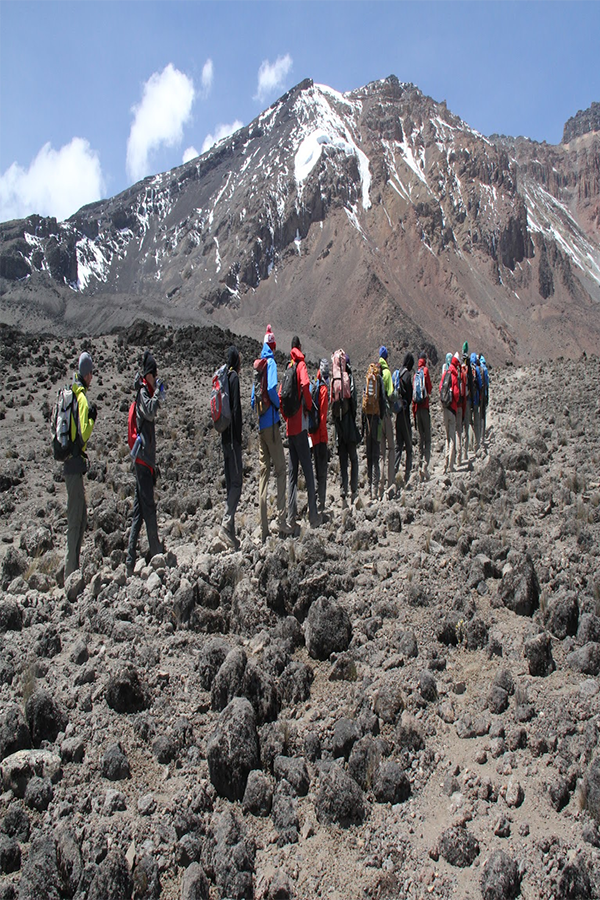
6 DAYS KILIMANJARO CLIMB MARANGU ROUTE
7 DAYS KILIMANJARO CLIMB MACHAME ROUTE
2 DAYS TANZANIA SAFARIS TARANGIRE AND NGORONGORO
3 DAYS TANZANIA WILDLIFE SAFARIS TARANGIRE, NGORONGORO AND LAKE MANYARA
4 DAYS TANZANIA WILDEBEEST MIGRATION SAFARIS
5 DAYS TANZANIA WILDEBEEST MIGRATION SAFARIS
5 DAYS ZANZIBAR HOLIDAY
LAKE MANYARA NATIONAL PARK DAY TRIP
TARANGIRE NATIONAL PARK DAY TRIP
MT. KILIMANJARO DAY HIKE
ARUSHA NATIONAL PARK DAY TRIPS